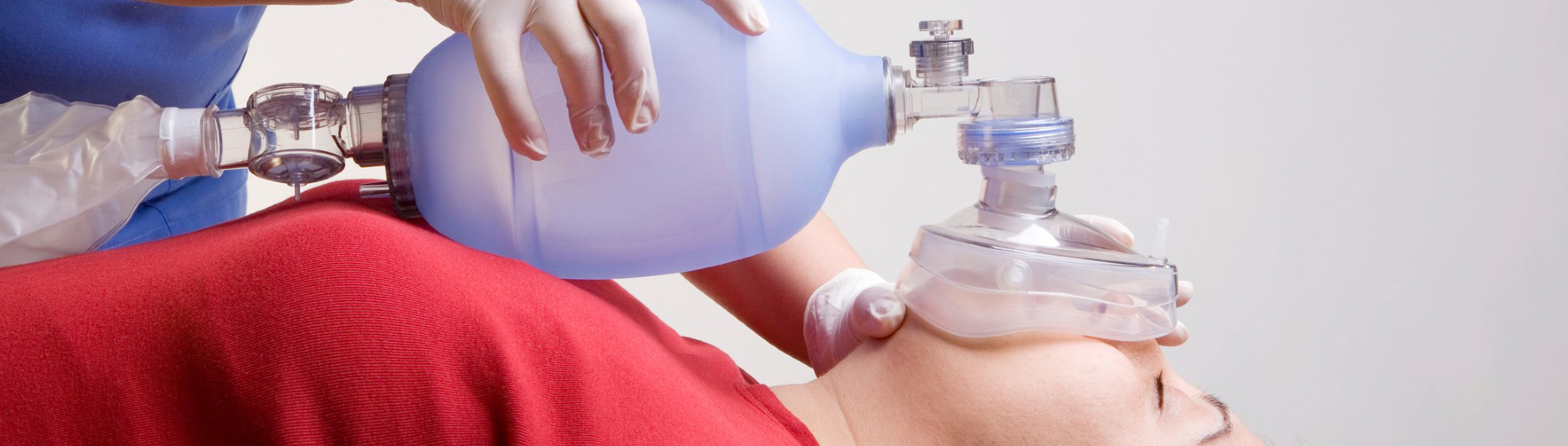

Un arrêt cardiaque survient sans prévenir. Votre réaction dans les premières minutes est cruciale pour la survie. Un masque de poche transforme la respiration artificielle en un geste sûr et hygiénique. Il crée une barrière entre vous et la victime tout en lui apportant l'oxygène vital.
Le taux de survie global jusqu'à la sortie de l'hôpital des patients dont l'accident n'a pas été constaté par les services d'urgence était de 8,5 %. Parmi ceux-ci, les patients ayant bénéficié d'une réanimation cardio-respiratoire par un témoin présentaient un taux de survie global plus élevé (11,2 %) que ceux n'ayant pas reçu de réanimation cardio-respiratoire (7,0 %).
Une technique correcte requiert trois éléments : le positionnement, l’étanchéité et la ventilation. Ce guide couvre les scénarios avec un ou deux secouristes, ainsi que les ajustements pour les enfants. Avec de la pratique, vous maîtriserez l’utilisation du masque de réanimation cardio-respiratoire de poche en toute confiance.masque de poche pour la réanimation cardio-respiratoirePourrait sauver une vie. Chaque masque de poche que vous avez sur vous est un gage de préparation.
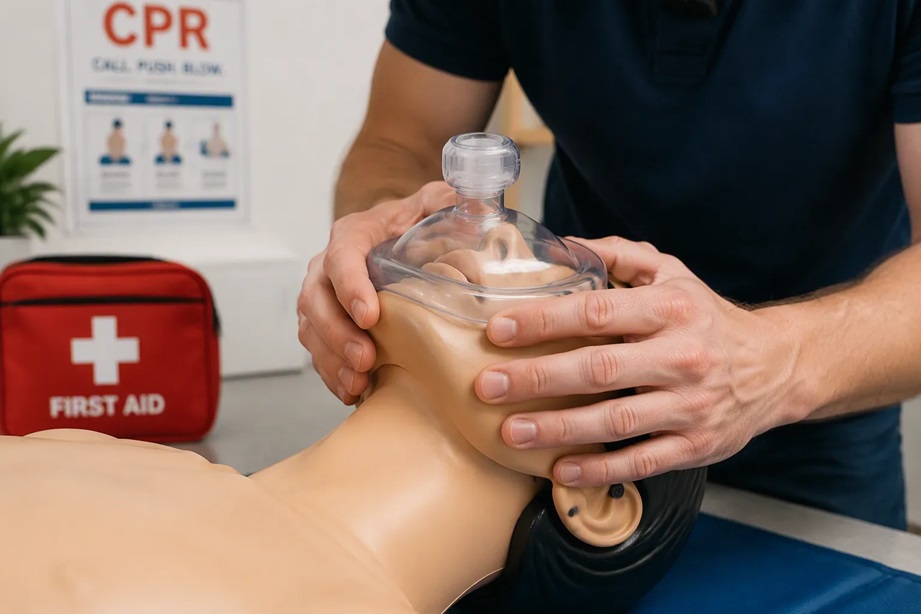
Un masque de poche est un dispositif compact qui peut sauver des vies. Vous vous demandez peut-être : qu’est-ce qu’un masque de poche pour la réanimation cardio-respiratoire ? Il se compose d’une pièce faciale souple en silicone durable ou en plastique haute densité. Une valve unidirectionnelle située au centre est reliée à un orifice de ventilation. Ce modèle simple permet d’effectuer des insufflations de sauvetage de manière sûre et efficace. Avoir un masque de poche sur soi est un gage de préparation aux situations d’urgence.
La valve unidirectionnelle est l'élément le plus important de tout masque de poche pour la réanimation cardio-respiratoire. Elle remplit deux fonctions essentielles :
Cette barrière réduit considérablement le risque de contamination croisée lors des insufflations de sauvetage. Sans cette valve, vous seriez directement exposé à l'air expiré par la victime et aux agents pathogènes potentiels.
La transparence est une autre caractéristique essentielle. Un masque transparent permet de voir la bouche et le nez de la victime. On peut ainsi observer le soulèvement de la poitrine et vérifier l'absence d'obstructions sans rompre l'étanchéité. De nombreux modèles sont équipés d'un orifice d'entrée d'oxygène. Cet orifice permet de brancher un tuyau d'oxygène pour une administration d'oxygène à concentration plus élevée. Le tableau ci-dessous présente les différences :
|
Fonctionnalité |
Sans O2Entrée |
Avec entrée d'oxygène |
|---|---|---|
|
accessoire d'oxygène |
Aucun tuyau ne peut être raccordé. |
Le tuyau se raccorde via l'entrée d'oxygène. |
|
apport d'oxygène |
Seul l'air expiré par le sauveteur |
Concentration d'oxygène plus élevée administrée au patient |
Le code couleur permet de choisir rapidement le masque adapté : rose pour les nourrissons, bleu pour les enfants et transparent pour les adultes. Une armature rigide assure un bon positionnement des mains lors des compressions thoraciques.
Votre rôle détermine les fonctionnalités les plus importantes. Consultez ce guide :
|
Type d'utilisateur |
Fonctionnalités recommandées |
Environnement d'utilisation typique |
|---|---|---|
|
Techniciens ambulanciers, paramédicaux, professionnels de la santé |
Sangle de tête, port d'oxygène, masques adulte/enfant |
Ambulances, hôpitaux, cliniques |
|
Personnel civil formé, entraîneurs, personnel de sécurité |
Compact cmasque taille unique, option porte-clés |
Véhicules, lieux de travail, salles de sport |
|
Instructeurs de RCR, formateurs d'entreprise |
Masques multiples, modèles de démonstration, valves remplaçables |
centres de formation, écoles |
|
Équipes d'urgence, intervention en cas de catastrophe |
Masques en vrac, de tailles variées. |
Événements faisant de nombreuses victimes, lieux publics |
Les hôpitaux et les services d'aide médicale d'urgence doivent évaluer la qualité d'étanchéité des masques, leurs caractéristiques de prévention des infections, leur compatibilité avec les équipements existants et leur conformité réglementaire. La valeur du contrat à long terme, incluant la formation et le réapprovisionnement, est également essentielle. Comparer le coût total de possession des masques de réanimation cardio-respiratoire proposés par différents fabricants, plutôt que le seul prix unitaire, permet aux acheteurs d'optimiser leur budget tout en garantissant performance clinique et fiabilité.
UNmasque de réanimation portableElle devrait se ranger facilement dans votre trousse de premiers secours ou votre boîte à gants. Tianzuo Medical propose une gamme de masques de poche durables et de haute qualité, adaptés à un usage professionnel et personnel. Leurs produits intègrent les caractéristiques essentielles mentionnées précédemment. Lors du choix de votre masque de poche, privilégiez l'étanchéité et la fiabilité de la valve. Un masque bien choisi devient un outil fiable en cas d'urgence.
Lors d'une intervention seule face à un arrêt cardiaque, votre position détermine votre efficacité. Agenouillez-vous au-dessus de la tête de la victime, en position céphalique. Cette position vous place directement au-dessus de son visage, vous offrant une vue dégagée pour la mise en place du masque et les compressions thoraciques. De ce point de vue, vous pouvez alterner compressions et insufflations sans bouger. Vous conservez également une vue complète de la cage thoracique de la victime afin de contrôler son soulèvement à chaque insufflation.
L'orientation de votre masque de poche sur le visage de la victime est déterminante pour une étanchéité réussie. Suivez ces étapes pour une technique correcte :
Placez le bord inférieur du masque entre la lèvre inférieure et le menton.
Positionnez le côté pointu du masque sur le nez.
Appuyez fermement les bords du masque sur le visage de la victime pour créer un joint étanche.
Center the pocket mask over the victim's nose and mouth, ensuring that it covers both areas completely to prepare for a secure seal.
The mask's shape guides you naturally. The narrow end fits over the nasal bridge, while the wider portion covers the mouth. When you position the mask correctly, you do not need to pinch the victim's nose shut. The mask itself creates the seal around both openings. Use your thumbs to press down on the sides of the mask while your fingers lift the jaw upward. This maneuver opens the airway and maintains the seal simultaneously. Your grip should remain firm but controlled, avoiding excessive pressure that could distort the mask's shape.
With the mask sealed, you can begin rescue breathing. Tilt the victim's head back slightly to open the airway, then deliver each breath over one full second. Watch the chest rise with each breath you give. The chest should visibly lift, indicating that air enters the lungs. If the chest does not rise, reposition the mask and re-tilt the head before trying again.
The ventilation rate for adult CPR follows a specific rhythm:
This ratio means you perform 30 compressions, then pause briefly to deliver two breaths. The pause should last no longer than 10 seconds to minimize interruptions in blood flow. After each breath, allow the chest to fall completely before giving the next one. This passive exhalation prevents air trapping and prepares the lungs for the following breath.
Your cpr pocket mask serves as your primary tool for effective ventilation during solo resuscitation. The one-way valve ensures that the air you deliver reaches the victim without exposing you to their exhaled breath. This protection allows you to focus on the task rather than worrying about contamination.
Mastering these instructions transforms your portable CPR mask from a passive accessory into an active life-saving instrument. Practice the positioning and breath delivery until they become muscle memory. When you use pocket cpr mask techniques correctly, you provide the victim with the oxygen their brain and heart desperately need. Your airway control during these critical moments directly influences the outcome of the resuscitation effort. Each breath you deliver represents a deliberate, skilled action that keeps the victim alive until advanced help arrives.
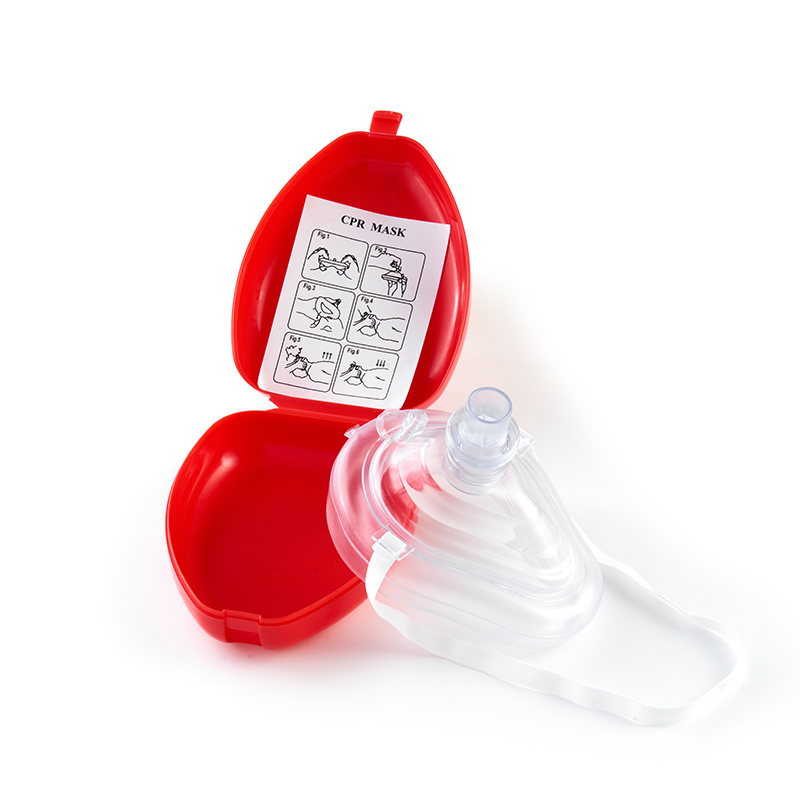
Two-rescuer CPR changes the dynamics of resuscitation. One person handles airway control while the other maintains blood flow through compressions. This division of labor reduces fatigue and improves the quality of both ventilations and chest compressions. The cpr pocket mask becomes the central tool for the rescuer managing the airway.
Rescuer 1 kneels beside the victim's chest and performs compressions. Rescuer 2 positions themselves at the victim's head, holding the pocket mask in place. This cephalic position gives you a direct line of sight to monitor chest rise with each breath.
Your role as the airway rescuer demands both hands on the mask. Place your thumbs along the sides of the mask and your fingers under the victim's jaw. Lift the jaw upward while pressing the mask firmly against the face. This dual action opens the airway and creates an airtight seal simultaneously. You do not need to pinch the nose because the mask covers both the nose and mouth completely.
The 2005 Emergency Cardiac Care guidelines for basic life support (BLS) recommend a compression to ventilation ratio of30:2for two-rescuer CPR. Although the source specifically mentions a bag-valve mask, the same ratio applies when using a pocket mask, as the ratio is device-independent and based on minimizing no-flow time.
Maintain your grip throughout the entire resuscitation. A loose seal allows air to escape, reducing the effectiveness of each breath. Your partner depends on your airway control to deliver oxygen efficiently.
The 30:2 ratio forms the backbone of your coordination. Rescuer 1 delivers 30 compressions at a rate of 100–120 per minute, with a depth of 2–2.4 inches and full chest recoil. After the 30th compression, Rescuer 1 pauses briefly. You then deliver two rescue breaths, each lasting one second, watching for visible chest rise.
Timing matters more than you might expect. Research shows that using a pocket mask significantly reduces the time needed for each ventilation compared to mouth-to-mouth. The table below illustrates this difference:
|
Metric |
Pocket Mask |
Mouth-to-Mouth |
|---|---|---|
|
Time per ventilation cycle |
0.923 sec (±0.432) |
1.021 sec (±0.535) |
|
Delay before restarting compressions |
9.88 sec (±2.831) |
10.21 sec (±4.112) |
The pause between the last breath and the resumption of compressions must stay under 10 seconds. Studies indicate that the group performing mouth-to-mouth ventilation exhibited longer interruptions in chest compressions compared to the group using a pocket mask. This finding aligns with the American Heart Association guidelines, which recommend not exceeding 10 seconds between completing two rescue breaths and initiating chest compressions. Your pocket mask helps you stay within this timeframe, optimizing the compression cycle.
Follow this sequence for smooth coordination:
Rescuer 1 performs 30 compressions, counting aloud to maintain rhythm.
Rescuer 1 pauses after the 30th compression.
You deliver 2 breaths through the mask, each lasting 1 second with visible chest rise.
Rescuer 1 resumes compressions immediately after the second breath.
Switch roles every 2 minutes or sooner if fatigue sets in, completing the switch in less than 5 seconds.
Communication drives effective ventilation. Count compressions aloud. Announce switches clearly. Confirm when the AED arrives. These verbal cues keep both rescuers synchronized and prevent unnecessary interruptions.
The use pocket cpr mask technique in a two-rescuer scenario demands practice. You must develop muscle memory for the mask seal and breath delivery. Your partner must trust that you will deliver breaths efficiently during each pause. Together, you provide the victim with continuous, high-quality resuscitation.
These instructions transform your portable CPR mask into a coordinated life-saving tool. Master the rhythm, maintain the seal, and communicate clearly. Your combined efforts give the victim the best chance for survival.
Children and infants require different techniques than adults. Their anatomy differs significantly. A standard pocket mask may not fit properly. You must adapt your approach to ensure effective ventilation without causing injury.
The head-tilt maneuver varies by age. For adults, you tilt the head back fully using the head-tilt-chin-lift technique. This position opens the airway completely. For infants, the rules change. You must not extend the head past the "sniffing" position, which means only slightly tilted back from neutral. An infant's head is proportionally larger than an adult's. Over-extension can actually block the airway rather than open it.
Mask size matters just as much as head position. If you have a smaller mask available, use it. A pediatric or infant mask creates a better seal on a child's face. Without a smaller mask, adjust the standard mask's position. Place the wider portion over the mouth and the pointed end over the nose. Press gently to create a seal without applying excessive pressure. Your airway control during this step determines whether breaths reach the lungs effectively.
Breath delivery changes dramatically for younger patients. You give smaller breaths with less force. Watch the chest rise carefully. The moment you see the chest lift, stop the breath. Over-inflating a child's lungs can cause damage. The ventilation rate also increases compared to adults.
|
Age Group |
Ventilation Rate |
Breath Interval |
|---|---|---|
|
Infants (under 1 year) |
20-30 breaths per minute |
One breath every 2-3 seconds |
|
Children (older than 1 year) |
20-30 breaths per minute |
One breath every 2-3 seconds |
These rates apply regardless of the device you use. Your CPR pocket mask delivers breaths efficiently at this pace. The one-way valve prevents contamination while you maintain the rhythm. For infants, cover both the nose and mouth with the mask. For older children, the mask may fit over the mouth with the nose pinched gently.
Your portable CPR mask serves as a versatile tool across age groups. Practice with different mask sizes to build confidence. Each breath you deliver through the pocket mask provides essential oxygen. This rescue breathing technique keeps the child's brain and organs functioning until advanced help arrives. Master these adjustments now, and you will respond correctly when a child needs you.
Cleaning immediately after use prevents the spread of germs. A dirty mask cannot deliver safe rescue breaths. You must clean your cpr pocket mask thoroughly before storing it for the next emergency. The process requires attention to detail and proper technique.
Begin by preparing yourself. Wear an unused pair of latex or vinyl gloves before handling the used mask. This protects you from direct contact with bodily fluids.
Follow these steps to disassemble the mask for cleaning:
Gently pull and twist the cylinder-shaped nozzle from the center of the mask to detach it.
This separates the two parts of the mask, allowing each component to be fully sterilized before reuse.
With both pieces separated, wash them with mild soap and warm water. Use a soft cloth or sponge to remove any visible debris. Rinse thoroughly to remove all soap residue.
Disinfection kills remaining pathogens. The following disinfectants work effectively on pocket mask materials:
Apply your chosen disinfectant according to the product instructions. Allow the solution to remain on the mask surfaces for the recommended contact time. This ensures complete sterilization of both parts.
After disinfection, let the mask components air dry completely. Do not use a towel to dry them. Towel fibers can scratch the mask surface or leave lint behind. Place the pieces on a clean, dry surface in a well-ventilated area. Drying typically takes 30 to 60 minutes depending on humidity.
Inspect the one-way valve carefully once the mask is dry. Look for cracks, tears, or deformation. The valve must seal properly to prevent backflow of air and fluids. If you find any damage, replace the entire pocket mask. A compromised valve puts you at risk during rescue breathing.
Reassemble the mask by reconnecting the nozzle to the center of the facepiece. Confirm that the connection feels secure and the valve moves freely. Place the mask back into its protective case. Store the case in a cool, dry location away from direct sunlight. Extreme heat can degrade the materials over time.
These manual cleaning steps ensure your pocket mask remains ready for the next emergency. A well-maintained portable CPR mask performs reliably when you need it most. Make cleaning a habit after every use.
Mastering the use pocket cpr mask requires three essential actions: position the mask correctly, achieve an airtight seal, and deliver breaths that visibly lift the chest. These steps form the proper technique that transforms a simple device into a life-saving tool. Your cpr pocket mask becomes an extension of your training when you practice regularly.
Confidence grows through repetition. Handle your pocket mask often. Practice the seal on family members or mannequins. Familiarity with your portable CPR mask ensures you respond without hesitation when seconds matter.
Tianzuo Medicaloffers durable masks designed for repeated practice and real emergencies. Invest time in mastering this skill today. One trained person with a pocket mask can change the outcome of a cardiac arrest. Be that person.
You should inspect your CPR pocket mask after every use. Check the one-way valve for cracks or tears. Replace the mask immediately if you notice any damage. Most manufacturers recommend replacing the mask every two to three years, even with proper care. Store it in a cool, dry place to extend its lifespan.
Yes, you can use a pocket mask on a person with facial hair. The seal may not be perfect, but you can improve it by applying firm pressure. Wet the beard area slightly if possible. This helps create a better seal. Continue rescue breaths even if you see some air leakage around the edges.
Même sans masque de poche, vous devez pratiquer la réanimation cardio-respiratoire (RCR). Utilisez un dispositif de protection comme une visière si vous en avez une. Sinon, effectuez une RCR par compressions thoraciques continues. Cette technique permet d'oxygéner la poitrine grâce au relâchement passif du thorax. Appelez immédiatement les services d'urgence et suivez leurs instructions jusqu'à leur arrivée.
Une formation formelle vous aide à maîtriser la technique appropriée, mais vous pouvez utiliser l'appareil sans certification. La conception du masque vous guide naturellement. Lisez attentivement le mode d'emploi fourni avec votre masque de réanimation portable. Entraînez-vous sur un mannequin ou un coussin pour gagner en confiance. En cas d'urgence, votre réactivité est plus importante qu'une technique parfaite.

 Réseau IPv6 pris en charge


 français
 English
 فارسی
فارسی Deutsch
 русский
 italiano
 español
 português
 العربية
 Türkçe